Why symptoms can overlap, what influences oxlate levels, and how to avoid another unnecessarily restrictive diet.
Spinach. Almonds. Beets. Sweet potatoes. Chocolate. These foods are nutrient-rich, yet they also appear on many lists of foods to avoid for histamine or oxalate problems.
If one of these foods leaves you itchy, bloated, headachy, tired, or simply feeling worse, it is understandable to wonder whether histamine and oxalates are connected. A quick internet search may make that connection sound well established.
The science is much less dramatic – and much more useful.
Histamine intolerance and altered oxalate handling are separate issues. At this time, we do not have clinical evidence showing that dietary oxalates directly cause
histamine intolerance or thathistamine intolerance causes oxalate intolerance. Some people may have concerns involving both, but overlapping symptoms or foods do not prove that one is driving the other.
That distinction matters. If we assume every reaction is caused by both histamine and oxalates, the food list can become very small very quickly. Before sending spinach to nutritional witness protection, it helps to understand what oxalates are, where they come from, and who has reason to investigate them.
The Short Answer
Histamine and oxalates follow different biological pathways. They can involve some of the same foods and may overlap with shared gut or metabolic concerns, but no direct histamine-oxalate connection has been established.
What Are Oxalates?
Oxalate is a small organic compound found in many plant foods. The body also produces it as the final product of several metabolic pathways.
Because humans cannot break oxalate down further, they must eliminate it, primarily through the kidneys and urine, with a smaller amount leaving through the digestive tract.
In normal amounts, this process happens quietly. Problems arise when internal oxalate production, intestinal absorption, or kidney excretion becomes unbalanced.
Excess oxalate in the urine is called hyperoxaluria. It can raise the risk of calcium oxalate kidney stones and, in more serious cases, kidney injury.
This is different from using the broad term oxalate toxicity to explain headaches, insomnia, thyroid symptoms, joint pain, skin problems, and digestive symptoms. Those symptoms are real, but they are not specific enough to prove that oxalate is the cause.
Most Oxalate Does Not Come Directly From Food
One of the biggest misunderstandings about oxalates is that they come mainly from spinach, sweet potatoes, nuts, beets, or other high-oxalate foods.
In healthy people, researchers estimate that the liver produces approximately 50 to 80 percent of the body’s oxalate. The amount varies with diet, intestinal absorption, kidney function, genetics, and metabolic health, but the important point is that oxalate is not only a dietary issue. [1]
Many metabolic pathways converge at glyoxylate, the immediate precursor to oxalate. Under balanced conditions, enzymes direct glyoxylate toward glycine or glycolate. When those pathways are disrupted or overwhelmed, more glyoxylate may be converted to oxalate.
Internally produced or endogenous contributors may include:
- Hydroxyproline, a compound required for collagen production, is released through normal collagen turnover, which is estimated to contribute about 15 percent of urinary oxalate in healthy people.
- Metabolic byproducts like glycolate and glyoxal produced through several metabolic and oxidative pathways.
- Smaller contributions from glycine or other amino acids (protein building blocks)
- Large supplemental doses of vitamin C or ascorbic acid, which can be converted to oxalate.
This is why a person can have an elevated oxalate marker without eating an obviously high-oxalate diet – and why removing every plant food on a list may miss the larger picture.
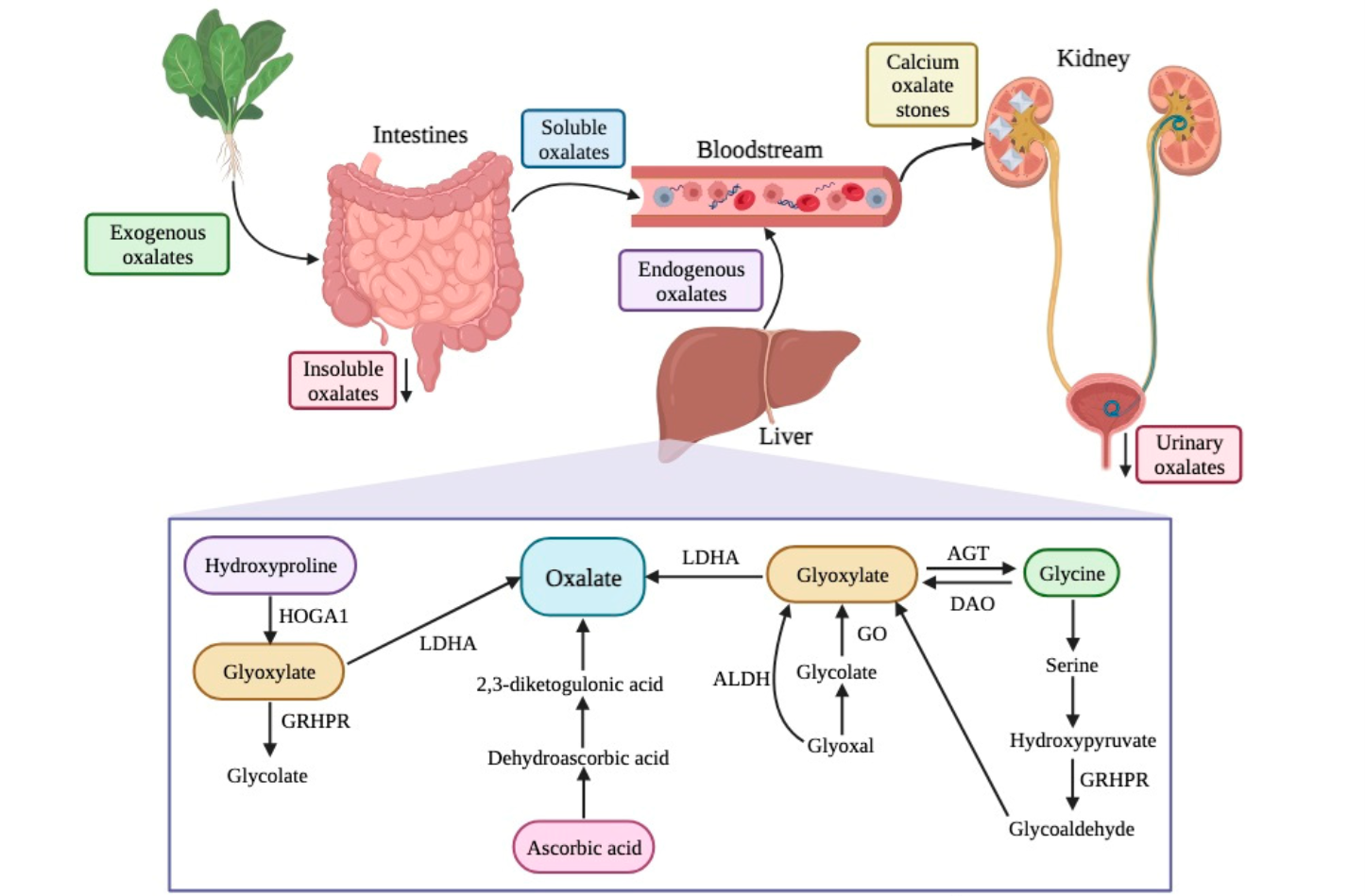
Image courtesy of: Oxalate in Foods: Extraction Conditions, Analytical Methods,
Occurrence, and Health Implications
High-Dose Vitamin C Can Increase Oxalate
Vitamin C is often recommended for immune health and histamine support, but more is not always better. The body can metabolize ascorbic acid into oxalate. In a controlled study, taking 1,000 mg of vitamin C twice daily increased urinary oxalate and calcium oxalate stone risk in a substantial portion of both stone-formers and non-stone-formers. [4]
In my clinical work, I have repeatedly seen elevated oxalate markers on an Organic Acids Test in clients using high-dose vitamin C. When that pattern appears, I review vitamin C intake first.
An elevated OAT marker should still be interpreted carefully. It can provide a useful clue, especially when it fits the supplement history and other findings, but it does not diagnose hyperoxaluria, primary hyperoxaluria, or a total-body oxalate burden. Laboratory handling also matters because ascorbic acid can convert to oxalate in a collected sample under certain conditions. [1]
More vitamin C is not necessarily better. The body absorbs vitamin C most efficiently in smaller amounts, while absorption becomes less efficient as supplemental doses increase.
The vitamin C left in the digestive tract can draw in water, contributing to diarrhea, cramping, or digestive irritation—especially in someone who already has a sensitive gut. Very high doses may also increase urinary oxalate in susceptible individuals. High-dose antioxidants can sometimes interfere with the natural oxidative signals the body uses to strengthen its own antioxidant defenses, so the goal should be to support antioxidant balance—not overwhelm the body with megadoses.
Could Blood Sugar Influence Oxalate Production?
Blood sugar may be another piece of the endogenous oxalate puzzle. When glucose remains elevated, the body produces compounds that may enter pathways involved in oxalate formation. Some studies have also found higher urinary oxalate in people with diabetes.
However, this does not prove that high blood sugar causes an oxalate problem. Current research suggests that this pathway may contribute only a small amount of oxalate.
Keeping blood sugar steadier is still worthwhile. Blood sugar swings can contribute to shakiness, headaches, anxiety, fatigue, and a racing heart—symptoms that may be mistaken for, or add to, a histamine reaction.
Supporting balanced blood sugar may improve the overall symptom picture, but it should not be promoted as a treatment for high oxalates.
Low Vitamine B6 May Also Matter
Vitamin B6, in its active pyridoxal-5-phosphate form, is required by an enzyme that helps convert glyoxylate into glycine rather than oxalate. This makes inadequate B6 a reasonable factor to consider when endogenous oxalate production appears elevated.
In a controlled depletion study involving young women, urinary oxalate increased during vitamin B6 depletion. [5]
Vitamin B6 is also an established treatment for certain genetically responsive forms of primary hyperoxaluria, although that is a rare medical disorder and not the same as having a mildly elevated oxalate marker.
This does not mean that everyone with suspected oxalate concerns should begin high-dose B6. Consider B6 status alongside diet, absorption, medications, genetics, symptoms, and laboratory findings. Long-term excessive B6 can also cause nerve injury, making a more-is-better approach particularly unhelpful.
How Gut Health Can Affect Oxalate Absorption
The gut is one meaningful area of overlap, but not because oxalates and histamine are the same problem.
Normally, calcium within a meal can bind oxalate in the digestive tract, creating a complex that is less likely to be absorbed.
With fat malabsorption, unabsorbed fatty acids bind to calcium instead. That leaves more free oxalate available for absorption through the intestine. [3]
Enteric hyperoxaluria is most often associated with significant fat malabsorption or intestinal disease, including inflammatory bowel disease, certain bariatric surgeries, pancreatic insufficiency, or extensive small-bowel problems. It is more complicated than simply having sluggish bile flow, and bile itself does not bind oxalate to calcium.
The microbiome can also influence intestinal oxalate handling. Oxalobacter formigenes is one of several organisms able to degrade oxalate, but oxalate metabolism depends on a microbial community rather than one magical bacterium.
Antibiotics, diet, intestinal conditions, and other factors may change this ecosystem. Current research has not established that a specific probiotic reliably corrects hyperoxaluria. [1,3]
Gut inflammation and dysbiosis may also influence histamine production or degradation through different mechanisms. This creates shared terrain, not proof that oxalates directly raise histamine. Two roads can pass through the same town without becoming the same road.
Why Histamine and Oxalates Reactions Are Easy to Confuse
Three main reasons these concerns get tangled online.
- Some foods appear on both avoidance lists. Spinach, almonds, chocolate, beets, and sweet potatoes may be blamed during a low-histamine journey even though oxalate, other food compounds, FODMAPs, portion size, or digestion may better explain a reaction.
- The symptoms are nonspecific. Bloating, discomfort, fatigue, headaches, bladder irritation, itching, and feeling unwell can have many causes. Symptoms alone cannot tell us whether histamine, oxalate, another food chemical, or something unrelated is responsible.
- Restrictive diets often overlap. Once someone is avoiding histamine, oxalates, salicylates, FODMAPs, gluten, dairy, and several other categories, it becomes nearly impossible to identify which change helped – and much easier to become undernourished and afraid of food.
The more useful question is not: Are histamine and oxalates secretly connected?
It is: Which reaction pattern best fits the foods, timing, symptoms, health history, and objective findings?
Who Has a Stronger Reason to Investigate Oxalates?
A focused oxalate evaluation may be more appropriate when someone has:
- Recurrent calcium oxalate kidney stones or a strong family history of stones.
- High urinary oxalate documented through an appropriate urine evaluation.
- A history of bariatric surgery, inflammatory bowel disease, pancreatic insufficiency, chronic fat malabsorption, or significant small-bowel disease.
- Kidney disease or reduced kidney function.
- A very concentrated daily intake of high-oxalate foods, such as large spinach smoothies combined with almond milk, almond butter, or almond flour.
- Very early or recurrent kidney stones that raise concern for rare primary hyperoxaluria.
Primary hyperoxaluria is a rare inherited group of disorders in which the liver overproduces oxalate. It is not the most common explanation for food reactions or a mildly elevated OAT marker. Diagnosis requires medical evaluation using appropriate urine, blood, and genetic testing. [8]
For people with recurrent stones, a 24-hour urine collection can measure oxalate along with urine volume, calcium, citrate, sodium, uric acid, and other stone-risk factors. This provides a more relevant assessment than diagnosing based on symptoms alone. [7]
What About Oxalate Dumping?
Oxalate dumping is commonly described online as stored oxalate crystals suddenly leaving tissues after a person reduces dietary oxalate. Reported symptoms include sandy stools, painful urination, rashes, fatigue, mood changes, and body pain.
People can certainly feel worse after abruptly changing their diet. However, clinical research has not established the proposed dumping mechanism, and it is not recognized as a defined phase of treating hyperoxaluria.
Systemic oxalosis is real, but it occurs when severe hyperoxaluria and impaired kidney clearance allow calcium oxalate to accumulate in organs and tissues. It is primarily seen in serious primary hyperoxaluria or advanced kidney failure.
That is very different from the claim that a person with normal kidney function begins releasing sharp crystals from the thyroid or other tissues after eating less spinach.
Why might someone feel worse after suddenly reducing high-oxalate foods?
- The new diet may also be lower in carbohydrates, calories, fiber, magnesium, potassium, or other nutrients.
- A major change in fiber and food variety can alter bowel habits and the microbiome.
- Several foods may have been removed at once, making it difficult to identify the actual trigger.
- The original symptoms may be fluctuating for reasons unrelated to oxalate.
A gradual, monitored change can still be a reasonable approach when oxalate reduction is justified. The reason is to preserve nutrition, avoid unnecessary upheaval, and observe patterns more accurately – not because we have proven that crystals are dumping from tissues.
Do You Need A Low-Histamine and Low-Oxalate Diet?
Usually, not without evidence that both are relevant.
Combining the two diets can remove many fruits, vegetables, nuts, seeds, legumes, seasonings, leftovers, fermented foods, and protein options. For someone who is already reacting unpredictably, that can create a diet that feels safer in the short term but becomes nutritionally and emotionally difficult to sustain.
Before combining restrictive diets, ask:
- Is the suspected food consistently high in oxalate, or does its content vary by portion, preparation, or source?
- Is the reaction reproducible, and what is the timing?
- Could FODMAPs, salicylates, amines, sulfur compounds, fat content, blood sugar changes, or digestive capacity better explain the response?
- Is there a kidney stone, malabsorption, or laboratory reason to focus on oxalate?
- Has the overall diet become so limited that the restriction itself is creating new problems?
Stop Blaming Every Healthy Food
The Food Reaction Decoder can help you compare histamine, oxalates, FODMAPs, sulfur, gut health, hormones, and inflammation so you can begin identifying the pattern that fits. Explore the Food Reaction Decoder
How to Lower Oxalate Exposure Without Fearing Food
If oxalate reduction is appropriate, the goal is usually to reduce excessive exposure while maintaining a varied, nourishing diet – not to chase a perfectly oxalate-free menu.
Identify concentrated sources first. A large daily spinach smoothie made with almond milk and almond butter creates a very different exposure than occasionally eating a modest serving of sweet potato. Start with the repeated, concentrated sources instead of eliminating every food that appears on a list.
Include adequate calcium with meals. Calcium can bind dietary oxalate in the intestine and reduce absorption. Tolerated milk or fresh dairy foods can be practical calcium sources and are not automatically high in histamine. Calcium-fortified alternatives may also work when tolerated. People with kidney disease or a history of stones should discuss calcium supplements with their medical provider rather than guessing at a dose. [7]
Stay appropriately hydrated. Adequate urine volume is one of the most important protective factors for kidney stones. Fluid needs should be individualized for kidney, heart, or other medical conditions.
Use preparation methods strategically. Boiling certain vegetables and discarding the cooking water can substantially reduce soluble oxalate, although the effect varies by food. Steaming is generally less effective. [6]
Review supplements before restricting more food. High-dose vitamin C deserves particular attention. Review the full list for dose, duplication, kidney considerations, and whether each product is still needed.
Protect the rest of the diet. Maintain adequate protein, fiber, minerals, carbohydrates, and food variety. A lower-oxalate plan should not quietly become a low-everything plan.
Use medical testing when the kidney story warrants it. Recurrent stones, blood in the urine, severe flank pain, painful urination, reduced kidney function, or persistently high urinary oxalate should be evaluated medically.
The Bottom Line on Histamine and Oxlaates
Histamine intolerance and altered oxalate handling can coexist, but they are not interchangeable diagnoses and do not have a confirmed direct relationship.
Oxalate homeostasis reflects a balance among endogenous production, dietary intake, intestinal absorption, the microbiome, kidney excretion, nutrient status, and genetics. High-dose vitamin C, low vitamin B6, fat malabsorption, concentrated dietary exposure, kidney function, and possibly metabolic health may all influence that balance.
The answer is not automatically another endless food list.
If you react to spinach, almonds, sweet potatoes, chocolate, or other healthy foods, the goal is to identify the most likely pattern, reduce what is genuinely excessive, and preserve as much food variety as possible. A thoughtful plan should help you understand food again – not make you afraid of everything in the produce aisle.
When Food Reactions Keep Multiplying
If digestive symptoms, antibiotic history, poor tolerance, and an increasingly restricted diet are all part of the picture, the Food Tolerance & Gut Restoration Program brings those pieces together in one personalized, food-first plan. Explore the Food Tolerance & Gut Restoration Program
References
- Ermer T, Nazzal L, Tio MC, et al. Oxalate homeostasis. Nature Reviews Nephrology. 2023.
- Comas-Baste O, Sanchez-Perez S, Veciana-Nogues MT, et al. Histamine Intolerance: The Current State of the Art. Nutrients. 2020.
- Witting C, Langman CB, Assimos D, et al. Pathophysiology and Treatment of Enteric Hyperoxaluria. Clinical Journal of the American Society of Nephrology. 2021.
- Massey LK, Liebman M, Kynast-Gales SA. Ascorbate increases human oxaluria and kidney stone risk. Journal of Nutrition. 2005.
- Turnlund JR, Betschart AA, Liebman M, et al. Vitamin B-6 depletion followed by repletion with animal- or plant-source diets and calcium and magnesium metabolism in young women. American Journal of Clinical Nutrition. 1992.
- Chai W, Liebman M. Effect of different cooking methods on vegetable oxalate content. Journal of Agricultural and Food Chemistry. 2005.
- American Urological Association. Medical Student Curriculum: Kidney Stones.
- National Institute of Diabetes and Digestive and Kidney Diseases. Primary Hyperoxaluria Type 1.
Medical Disclaimer
The information provided in this article is for educational purposes only and is not intended to diagnose, treat, cure, or prevent any disease. Kidney stones, kidney disease, blood in the urine, severe pain, or suspected hyperoxaluria require evaluation by a qualified medical professional. Do not discontinue prescribed medication or begin high-dose supplements without consulting your healthcare provider.


Eileen Schutte, MS, CN, FMN – One of my greatest passions is helping clients overcome food intolerances, such as histamine intolerance and sensitivities, so they can enjoy food again. My other passion is genomics, focusing on histamine intolerance genes and how nutrition and lifestyle changes can support them. I hold a master’s degree in functional nutrition from the University of Bridgeport, Connecticut, graduating Summa Cum Laude. After completing my master’s degree, I earned my certification in Functional Medicine Nutrition and completed advanced genomic courses through Genomic Kitchen. I am also a GEMM (Gut Ecology, Metabolic Modulation) practitioner, and this program is the basis of my Food Tolerance Gut Restoration Program.